
The Card Players
Introduction: The "Father of Us All"
Paul Cézanne (1839–1906) occupies a unique and formidable position in the history of Western art. Often described as the "Father of Modern Art"—a title famously bestowed upon him by both Henri Matisse and Pablo Picasso—Cézanne was the primary bridge between the ephemeral observations of 19th-century Impressionism and the structural radicalism of 20th-century Cubism. His project was nothing less than a complete reimagining of the act of seeing. Where his contemporaries sought to capture the fleeting effects of light and atmosphere, Cézanne aimed for "something solid and durable, like the art of the museums."
This Production Note examines the rigorous intellectual and technical framework of Cézanne's work, tracing his evolution from his early, turbulent "dark period" to the serene, geometric essentialism of his final years in Aix-en-Provence.
I. The Early Years: The "Couillarde" Style and Romantic Turmoil (1861–1870)
Cézanne’s early work was characterized by a raw, almost violent expressive power that stood in stark contrast to the refined academicism of the Paris Salon. During the 1860s, he developed what he called the *manière couillarde* (the "ballsy" style), using a palette knife to apply thick, slab-like layers of paint. His subjects were often dark, psychological, and provocative—scenes of murder, abduction, and religious ecstasy.
Influenced by the romanticism of [Delacroix](/eugenedelacroix) and the realism of Courbet, these early works (such as the *Portrait of Uncle Dominique*, 1866) demonstrate an obsession with materiality. The paint is treated as a physical substance, a precursor to the tactile sensitivity that would define his later career. Even in this "barbaric" phase, one can see the seeds of his lifelong preoccupation with the weight and volume of objects.
II. The Impressionist Catalyst: [Pissarro](/camillepissarro) and the School of Pontoise (1872–1878)
The crucial turning point in Cézanne’s career came through his association with [Camille Pissarro](/camillepissarro). In the early 1870s, the two artists worked closely together in Pontoise and Auvers-sur-Oise. Under [Pissarro](/camillepissarro)’s mentorship, Cézanne abandoned his dark palette and heavy impasto in favor of the bright, broken colors of Impressionism.
However, Cézanne’s relationship with Impressionism was always one of critical engagement rather than total adherence. While he adopted the practice of painting *en plein air* (outdoors), he found the Impressionists' lack of structure dissatisfying. He famously stated his desire to "make of Impressionism something solid and durable."
Works from this period, like *The House of the Hanged Man* (1873), show him beginning to use small, parallel brushstrokes—a technique that would evolve into his signature "constructive stroke." He was no longer interested in the "accidental" light of [Monet](/claudemonet); he was searching for the permanent, underlying structure of the landscape.
III. The Constructive Stroke: Organizing Sensation (1880s)
By the 1880s, Cézanne had fully developed his mature style, centered on the **constructive stroke** (*tache*). This was a method of building up forms through organized patches of color. Each stroke was a "sensation"—a response to a specific optical stimulus—but together they formed a cohesive, tectonic whole.
This period saw a move away from traditional linear perspective. Cézanne realized that the human eye does not perceive the world from a single, static point. Instead, we see through a series of shifting glances. By incorporating multiple viewpoints into a single canvas, he challenged the Renaissance convention of the "window on the world."
In his landscapes, such as those of the *Gulf of Marseille seen from L'Estaque* (c. 1885), the sea is not a flat plane but a vibrant wall of blue, balanced by the geometric blocks of the village houses. The tension between the two-dimensional surface of the canvas and the three-dimensional depth of the scene became the central drama of his art.
IV. The Landscapes of Provence: Mont Sainte-Victoire
No subject is more associated with Cézanne than **Mont Sainte-Victoire**, the limestone mountain near his home in Aix-en-Provence. He painted it dozens of times over several decades, using it as a laboratory for his theories on form and color.
In his later versions of the mountain (c. 1902–1906), the representation becomes increasingly abstract. The mountain is no longer a specific geological entity but a configuration of planes and facets. He used **atmospheric perspective** in a revolutionary way: instead of blurring distant objects, he used cool blues and violets to suggest depth, while warm ochres and greens brought the foreground forward.
This rhythmic interplay of "cool" and "warm" tones allowed him to create a sense of space without relying on traditional drawing or shading. The mountain became a monumental expression of what he called "the harmony parallel to nature."
V. Still Lifes: The Logic of Color and the "Cylinder, Sphere, and Cone"
Cézanne’s still lifes are perhaps the most influential part of his oeuvre for the development of modernism. He famously advised the young artist Émile Bernard to "treat nature by the cylinder, the sphere, the cone." This was not a call for literal geometry, but a reminder to look for the essential volumes beneath the surface of things.
In works like *Still Life with Apples and Oranges* (c. 1899), the objects are imbued with a massive, monumental quality. An apple is not just a piece of fruit; it is a weight, a volume, and a field of color. Cézanne would spend hours arranging his still life compositions, often using coins or bits of paper to tilt a plate or a piece of fruit to find the perfect formal balance.
The "instability" of his still lifes—the way a table edge might not align or a vase might seem to tilt—was a deliberate attempt to capture the lived experience of vision. He was recording the process of looking, where the mind synthesizes multiple optical sensations into a single concept.
VI. The Late Works and The Bathers: The Search for a Synthesis
In his final years, Cézanne turned his attention to large-scale figurative compositions, most notably the **Bathers** series. These works represented his attempt to integrate the human figure into the landscape in a way that achieved the timeless grandeur of classical art (like that of Poussin) while remaining true to his modern observations.
*The Large Bathers* (1900–1906, Philadelphia Museum of Art) is the culmination of this effort. The figures are depersonalized, treated as architectural elements within a soaring vaulted space formed by the trees. The painting is a masterclass in **passage**—the technique of blurring the boundaries between adjacent planes of color so that the figure and the environment bleed into one another. This "interpenetration of form" would become a foundational principle of Cubism.
VII. Technical Mastery: Phenomenological Vision
To understand Cézanne is to understand his "slowness." He was a notoriously slow painter, sometimes requiring over a hundred sittings for a single portrait. Every brushstroke was the result of intense deliberation.
Key technical innovations include:
- **Passage:** The use of overlapping planes of color to unite different areas of the painting, breaking down the distinction between object and background.
- **Tectonic Form:** Building figures and landscapes as if they were masonry, giving them a sense of structural integrity.
- **Color Modulation:** Using subtle shifts in hue rather than value (light and dark) to describe volume.
- **The "Unfinished" Aesthetic:** Cézanne often left parts of the canvas bare. For him, a painting was "realized" when the logic of the sensations was complete, not necessarily when every inch of the canvas was covered.
VIII. Legacy: The Bridge to the 20th Century
Cézanne’s influence on the next generation of artists was profound. For the Fauves, he provided a new language of color. For the Cubists, he provided a new language of form. Picasso famously referred to him as "my one and only master," while Rilke wrote extensively about the "unswerving" nature of Cézanne's vision.
He transformed the role of the artist from a narrator or a decorator into an explorer of the structures of consciousness. By focusing on the *process* of perception rather than the *object* of perception, he laid the groundwork for the century of abstraction that followed his death.
Selected Works and Sourcing
- **Mont Sainte-Victoire** (c. 1902–1906): Sourced from The Metropolitan Museum of Art (ID: 435877). A prime example of his late, faceted landscape style.
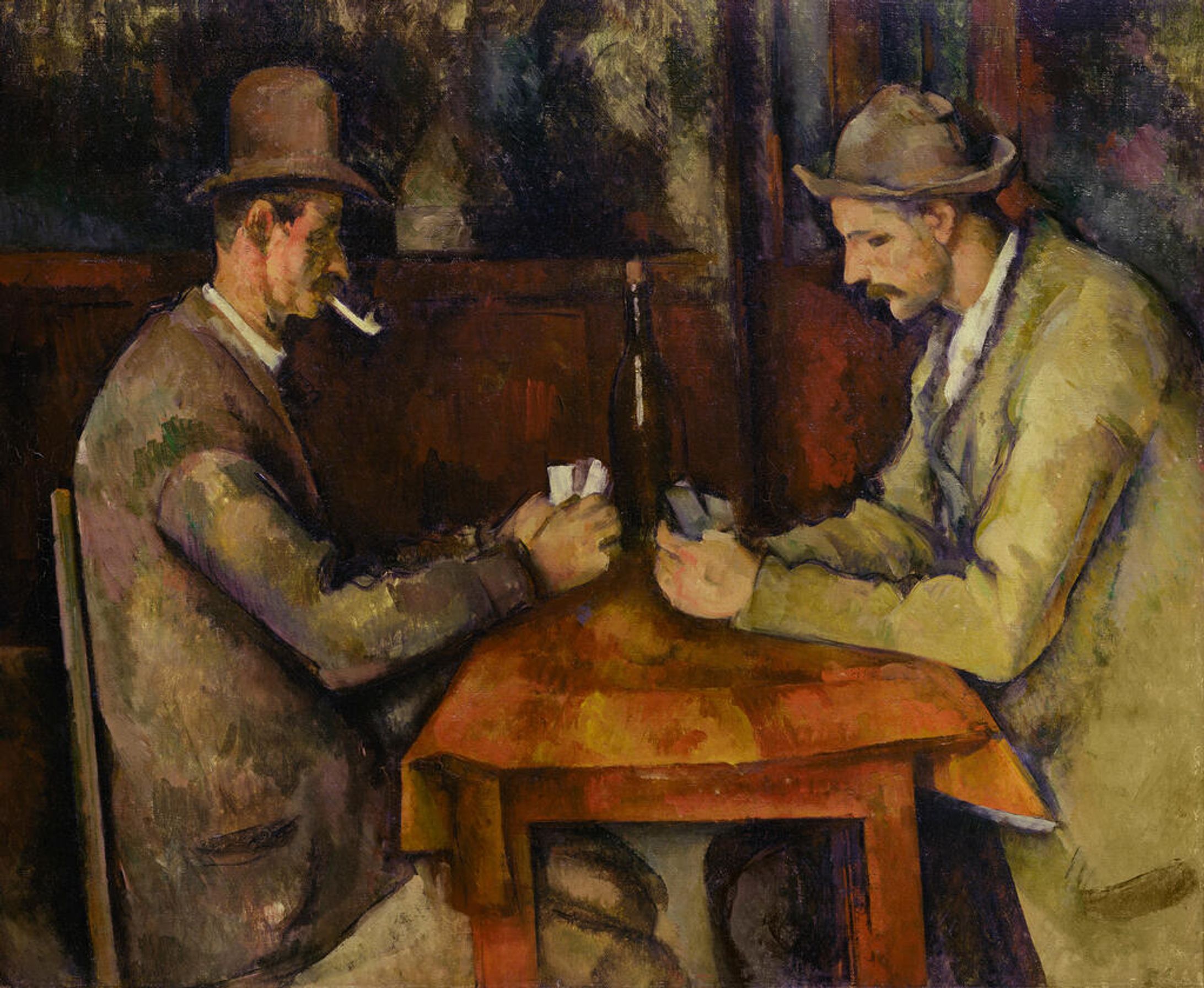
- **The Card Players** (1890–92): Sourced from The Metropolitan Museum of Art (ID: 435882). Demonstrates his ability to imbue everyday subjects with monumental dignity.
- **Still Life with Apples and a Pot of Primroses** (c. 1890): Sourced from The Metropolitan Museum of Art (ID: 435883). Shows the architectural arrangement of color and form in his still lifes.
- **The Gulf of Marseille Seen from L'Estaque** (c. 1885): Sourced from The Metropolitan Museum of Art (ID: 435880). A key work from his middle period exploring geometric structure in landscape.
Bibliography and Reliable Sources
1. **Cachin, Françoise, et al.** *Cézanne.* Philadelphia Museum of Art / Reunion des Musées Nationaux, 1996. (The definitive exhibition catalogue).
2. **Rewald, John.** *The Paintings of Paul Cézanne: A Catalogue Raisonné.* Harry N. Abrams, 1996.
3. **Shiff, Richard.** *Cézanne and the End of Impressionism: A Study of the Theory, Technique, and Critical Evaluation of Modern Art.* University of Chicago Press, 1984.
4. **The Metropolitan Museum of Art.** "Heilbrunn Timeline of Art History: Paul Cézanne (1839–1906)." URL: [https://www.metmuseum.org/toah/hd/pcez/hd_pcez.htm](https://www.metmuseum.org/toah/hd/pcez/hd_pcez.htm)
5. **Musée d'Orsay.** "Paul Cézanne: The Collections." URL: [https://www.musee-orsay.fr](https://www.musee-orsay.fr)
6. **Verdi, Richard.** *Cézanne.* Thames & Hudson (World of Art), 1992.


あなたのforiioを無料で作成