
Lithium-ion Battery Anode Materials Market Report: the global market is expected to reach approximately US$24.798 billion by 2032
クレジット

イラストレーター
Lithium-ion Battery Anode Materials Market Report: the global market is expected to reach approximately US$24.798 billion by 2032
The global market for Lithium-ion Battery Anode Materials was estimated to be worth US$ 9428 million in 2025 and is projected to reach US$ 24827 million, growing at a CAGR of 14.0% from 2026 to 2032.
Global Market Research Publisher QYResearch (QY Research) announces the release of its latest report “Lithium-ion Battery Anode Materials - Global Market Share and Ranking, Overall Sales and Demand Forecast 2026-2032”. Based on 2025 market situation and impact historical analysis (2021-2025) and forecast calculations (2026-2032), this report provides a comprehensive analysis of the global Lithium-ion Battery Anode Materials market, including market size, market share, market volume, demand, industry development status, and forecasts for the next few years.
The report provides advanced statistics and information on global market conditions and studies the strategic patterns adopted by renowned players across the globe. As the market is constantly changing, the report explores competition, supply and demand trends, as well as the key factors that contribute to its changing demands across many markets.
【Get a free sample PDF of this report (Including Full TOC, List of Tables & Figures, Chart)】
https://www.qyresearch.com/reports/5495365/lithium-ion-battery-anode-materials
Lithium-ion Battery Anode Materials: Powering the Scale-Up and Upgrade of the Global Battery Economy
Definition and Core Function
1.1. Lithium-ion battery anode materials are the active components of the negative electrode, engineered to enable reversible lithium-ion intercalation and deintercalation. They are the fundamental gatekeepers of charge and discharge.
1.2. These materials, typically based on artificial graphite, natural graphite, or silicon-based composites, are produced through a precise sequence of crushing, classification, spheroidization, surface coating, carbonization, graphitization, and screening.
1.3. Their core function extends beyond simple lithium-ion transfer. The anode material is a primary determinant of a battery's cycle life, rate and fast-charging capability, energy density, safety profile, low-temperature performance, and overall cost structure, making it a critical strategic material for the energy transition.
Market Size and Explosive Growth Trajectory
2.1. The global market is in a phase of parallel scale expansion and material-system upgrading, driven by the twin revolutions of transport electrification and stationary energy storage.
2.2. The market was valued at approximately US$9.428 billion in 2025 and is projected to surge to US$24.798 billion by 2032, at a powerful CAGR of approximately 14.0%.
2.3. This growth is fueled by rising EV penetration, massive energy storage deployment, the industry-wide push for fast-charging batteries, and the accelerating adoption of silicon-based materials in high-energy-density cells. The future increment will come primarily from EV battery upgrades, energy storage growth, localized supply chains in Europe and North America, and capacity relocation to Southeast Asia.
Competitive Landscape: A High-Concentration, Multi-Tiered Battle
3.1. The industry is defined by high concentration among leaders, strong regional clustering in China, and differentiation by technology route.
3.2. The first tier is firmly held by dominant players including BTR, Shanshan Technology, Hunan Zhongke Shinzoom, and Shangtai Technology, who command a high combined share of the global market through scale, cost, and deep customer qualification.
3.3. A competitive second tier—including Putailai/Zichen Technology, Kaijin New Energy, Xiangfenghua, and others—competes through specialized customer niches, regional capacity deployment, and integrated graphitization support.
3.4. Future competition will evolve beyond pure capacity expansion into a combined contest of customer mix quality, cost curve leadership, fast-charging performance, proven silicon-based mass production capability, and the speed of overseas supply-chain response.
Product and Application Segmentation
4.1. By Product Type: The market bifurcates into the mature, dominant carbon-based segment and the high-growth silicon-based segment.
4.1.1. Carbon-Based Anodes (Artificial and Natural Graphite): Feature mature technology, established supply chains, and favorable cost. They remain the undisputed workhorse for EV, energy storage, and consumer batteries.
4.1.2. Silicon-Based Anodes (Silicon-Carbon and Silicon-Oxide): Offer a dramatically higher theoretical capacity and are the critical path for improving energy density and fast-charging capability. Adoption is expanding from premium consumer electronics into high-nickel EV batteries and next-generation fast-charging designs.
4.2. By Application:
4.2.1. EV Batteries: The largest and most strategic demand driver.
4.2.2. Energy Storage Batteries: Prioritizes long cycle life, low cost, and supply stability.
4.2.3. Consumer Electronics Batteries: Focuses on volumetric energy density, high rate capability, and speed of premium material adoption.
Regional Dynamics: A China-Dominant, Globally Shifting Supply Chain
5.1. China as the Dominant Hub: China is the unrivaled center of both production and consumption. It accounts for approximately 93.81% of global production and 89.43% of global consumption in 2025, supported by an integrated battery value-chain cluster spanning EVs, energy storage, and materials.
5.2. Mature High-End Markets (Japan and South Korea): Remain critical for high-specification product validation and as key customers for premium battery materials.
5.3. The Rising Southeast Asian Node: Is emerging as a significant location for supply-chain spillover and regional customer support, with its production share expected to rise meaningfully.
5.4. The High-Growth Western Frontier: Europe and North America are starting from a low base but show the fastest growth, driven by localized battery gigafactory construction, supply-chain security imperatives, carbon-footprint regulations, and supportive industrial policies.
Industry Chain Deep Dive
6.1. Upstream: The foundation is built on raw materials (needle coke, petroleum coke, natural graphite, silicon precursors, pitch, and coating agents) and the key processing equipment for particle engineering and high-temperature treatment.
6.2. Midstream: Core manufacturing value lies in particle morphology control, impurity management, coating uniformity, graphitization efficiency, and batch-to-batch consistency across artificial graphite, natural graphite, and silicon-based anode products.
6.3. Downstream: The primary demand pull is from EV, energy storage, and consumer battery manufacturers.
6.4. Key Barriers and Value-Capture Points: Are concentrated in long customer qualification cycles, energy cost control in graphitization, continuous stable production, fast-charge and cycle-performance matching, and complex supply-chain management. The highest value-capture lies in graphitization, surface modification, premium silicon-based materials, and validation systems tightly linked to leading battery customers.
Policy Support and Structural Constraints
7.1. The industry is a direct beneficiary of industrial policies promoting new energy vehicles, energy storage, and new power systems.
7.2. However, it faces hard constraints from environmental compliance, energy consumption limits, carbon emission regulations, and export controls. Graphitization, in particular, is an energy-intensive process highly sensitive to power cost, energy quotas, and environmental rules.
7.3. Silicon-based anodes possess immense growth potential but still must overcome significant technical hurdles in expansion control, first-cycle efficiency, cycle stability, and large-scale cost reduction.
7.4. Overall, entry barriers stem not only from capital expenditure and scale, but from deep know-how in formulation, tight process window control, lengthy customer adoption cycles, absolute quality consistency, and upstream resource coordination.
Outlook: The Dual Track of Scale and Innovation
8.1. The anode materials industry is entering a decisive phase where the twin imperatives of massive volume scale-up and high-performance material upgrading will coexist and define competitive success.
8.2. Artificial graphite will remain dominant, with a clear product upgrade trajectory toward low expansion, fast charging, long cycle life, and low-carbon production.
8.3. Silicon-carbon and silicon-oxide materials will accelerate their transition from niche validation to mainstream scaled supply, driven by the premium battery segment.
8.4. Companies that can master integrated graphitization, secure strong customer qualification, deploy overseas supply capability, pioneer low-carbon manufacturing, and lead in new-material R&D will be the ones to capture not just market share, but durable pricing resilience and order stability in the next cycle of growth. The anode is no longer just a material; it is the architecture of battery performance.
The report provides a detailed analysis of the market size, growth potential, and key trends for each segment. Through detailed analysis, industry players can identify profit opportunities, develop strategies for specific customer segments, and allocate resources effectively.
The Lithium-ion Battery Anode Materials market is segmented as below:
By Company
BTR New Energy
Shanshan Tech
Resonac
POSCO Future M
Mitsubishi Chem
Nippon Carbon
Shinzoom
Shangtai Tech
Putailan (Zichen Tech)
Guangdong Kaijin
Carbon One
KEDA
Guangdong Dongdao
Xiangfenghua
Hebei Kuntian
Sinuo
Henan Yicheng
ZETO
Segment by Type
Carbon-based Anode
Silicon-based Anode
Segment by Application
Power Battery
Energy Storage Battery
Consumer Electronics Battery
Each chapter of the report provides detailed information for readers to further understand the Lithium-ion Battery Anode Materials market:
Chapter 1: Introduces the report scope of the Lithium-ion Battery Anode Materials report, global total market size (valve, volume and price). This chapter also provides the market dynamics, latest developments of the market, the driving factors and restrictive factors of the market, the challenges and risks faced by manufacturers in the industry, and the analysis of relevant policies in the industry. (2021-2032)
Chapter 2: Detailed analysis of Lithium-ion Battery Anode Materials manufacturers competitive landscape, price, sales and revenue market share, latest development plan, merger, and acquisition information, etc. (2021-2026)
Chapter 3: Provides the analysis of various Lithium-ion Battery Anode Materials market segments by Type, covering the market size and development potential of each market segment, to help readers find the blue ocean market in different market segments. (2021-2032)
Chapter 4: Provides the analysis of various market segments by Application, covering the market size and development potential of each market segment, to help readers find the blue ocean market in different downstream markets.(2021-2032)
Chapter 5: Sales, revenue of Lithium-ion Battery Anode Materials in regional level. It provides a quantitative analysis of the market size and development potential of each region and introduces the market development, future development prospects, market space, and market size of each country in the world..(2021-2032)
Chapter 6: Sales, revenue of Lithium-ion Battery Anode Materials in country level. It provides sigmate data by Type, and by Application for each country/region.(2021-2032)
Chapter 7: Provides profiles of key players, introducing the basic situation of the main companies in the market in detail, including product sales, revenue, price, gross margin, product introduction, recent development, etc. (2021-2026)
Chapter 8: Analysis of industrial chain, including the upstream and downstream of the industry.
Chapter 9: Conclusion.
Benefits of purchasing QYResearch report:
Competitive Analysis: QYResearch provides in-depth Lithium-ion Battery Anode Materials competitive analysis, including information on key company profiles, new entrants, acquisitions, mergers, large market shear, opportunities, and challenges. These analyses provide clients with a comprehensive understanding of market conditions and competitive dynamics, enabling them to develop effective market strategies and maintain their competitive edge.
Industry Analysis: QYResearch provides Lithium-ion Battery Anode Materials comprehensive industry data and trend analysis, including raw material analysis, market application analysis, product type analysis, market demand analysis, market supply analysis, downstream market analysis, and supply chain analysis.
and trend analysis. These analyses help clients understand the direction of industry development and make informed business decisions.
Market Size: QYResearch provides Lithium-ion Battery Anode Materials market size analysis, including capacity, production, sales, production value, price, cost, and profit analysis. This data helps clients understand market size and development potential, and is an important reference for business development.
Other relevant reports of QYResearch:
Global Lithium-ion Battery Anode Materials Market Outlook, In‑Depth Analysis & Forecast to 2032
Global Lithium-ion Battery Anode Materials Sales Market Report, Competitive Analysis and Regional Opportunities 2026-2032
Global Lithium-ion Battery Anode Materials Market Research Report 2026
Global Lithium Ion Battery Anode Materials Market Outlook, In‑Depth Analysis & Forecast to 2032
Global Lithium Ion Battery Anode Materials Market Research Report 2026
Global Lithium Ion Battery Anode Materials Sales Market Report, Competitive Analysis and Regional Opportunities 2026-2032
Lithium Ion Battery Anode Materials- Global Market Share and Ranking, Overall Sales and Demand Forecast 2026-2032
Binder for Lithium-ion Battery Anode Materials- Global Market Share and Ranking, Overall Sales and Demand Forecast 2026-2032
Global Binder for Lithium-ion Battery Anode Materials Sales Market Report, Competitive Analysis and Regional Opportunities 2026-2032
Global Binder for Lithium-ion Battery Anode Materials Market Research Report 2026
Global Binder for Lithium-ion Battery Anode Materials Market Outlook, In‑Depth Analysis & Forecast to 2032
To contact us and get this report: https://www.qyresearch.com/contact-us
About Us:
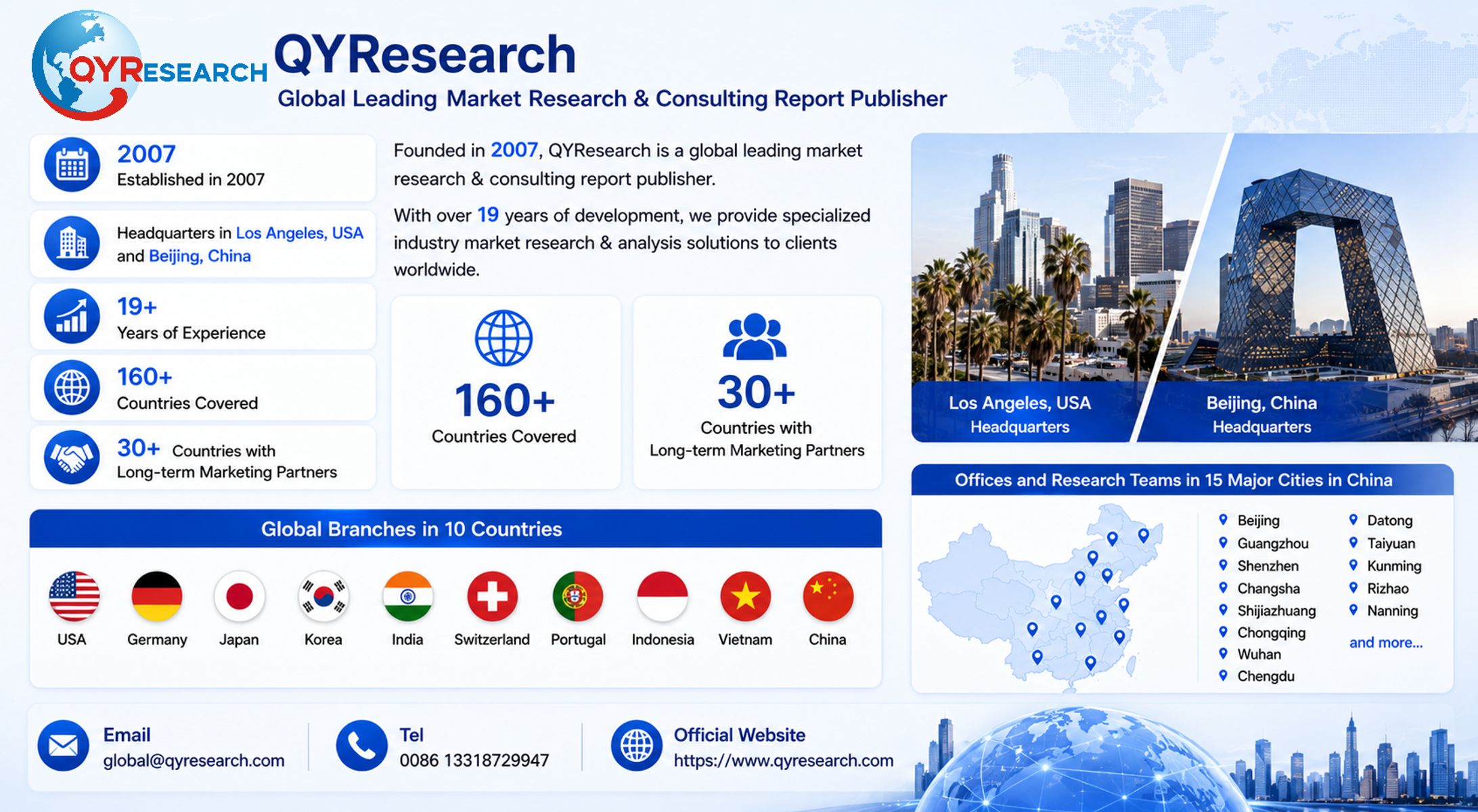
QYResearch founded in California, USA in 2007, which is a leading global market research and consulting company. Our primary business include market research reports, custom reports, commissioned research, IPO consultancy, business plans, etc. With over 19 years of experience and a dedicated research team, we are well placed to provide useful information and data for your business, and we have established offices in 7 countries (include United States, Germany, Switzerland, Japan, Korea, China and India) and business partners in over 30 countries. We have provided industrial information services to more than 60,000 companies in over the world.
Contact Us:
If you have any queries regarding this report or if you would like further information, please contact us:
QY Research Inc.
Add: 17890 Castleton Street Suite 369 City of Industry CA 91748 United States
EN: https://www.qyresearch.com
E-mail: global@qyresearch.com
Tel: 001-626-842-1666(US)
JP: https://www.qyresearch.co.jp
クレジット
イラストレーター


あなたのforiioを無料で作成
Lithium-ion Battery Anode Materials Market Report: the global market is expected to reach approximately US$24.798 billion by 2032
The global market for Lithium-ion Battery Anode Materials was estimated to be worth US$ 9428 million in 2025 and is projected to reach US$ 24827 million, growing at a CAGR of 14.0% from 2026 to 2032.
Global Market Research Publisher QYResearch (QY Research) announces the release of its latest report “Lithium-ion Battery Anode Materials - Global Market Share and Ranking, Overall Sales and Demand Forecast 2026-2032”. Based on 2025 market situation and impact historical analysis (2021-2025) and forecast calculations (2026-2032), this report provides a comprehensive analysis of the global Lithium-ion Battery Anode Materials market, including market size, market share, market volume, demand, industry development status, and forecasts for the next few years.
The report provides advanced statistics and information on global market conditions and studies the strategic patterns adopted by renowned players across the globe. As the market is constantly changing, the report explores competition, supply and demand trends, as well as the key factors that contribute to its changing demands across many markets.
【Get a free sample PDF of this report (Including Full TOC, List of Tables & Figures, Chart)】
https://www.qyresearch.com/reports/5495365/lithium-ion-battery-anode-materials
Lithium-ion Battery Anode Materials: Powering the Scale-Up and Upgrade of the Global Battery Economy
Definition and Core Function
1.1. Lithium-ion battery anode materials are the active components of the negative electrode, engineered to enable reversible lithium-ion intercalation and deintercalation. They are the fundamental gatekeepers of charge and discharge.
1.2. These materials, typically based on artificial graphite, natural graphite, or silicon-based composites, are produced through a precise sequence of crushing, classification, spheroidization, surface coating, carbonization, graphitization, and screening.
1.3. Their core function extends beyond simple lithium-ion transfer. The anode material is a primary determinant of a battery's cycle life, rate and fast-charging capability, energy density, safety profile, low-temperature performance, and overall cost structure, making it a critical strategic material for the energy transition.
Market Size and Explosive Growth Trajectory
2.1. The global market is in a phase of parallel scale expansion and material-system upgrading, driven by the twin revolutions of transport electrification and stationary energy storage.
2.2. The market was valued at approximately US$9.428 billion in 2025 and is projected to surge to US$24.798 billion by 2032, at a powerful CAGR of approximately 14.0%.
2.3. This growth is fueled by rising EV penetration, massive energy storage deployment, the industry-wide push for fast-charging batteries, and the accelerating adoption of silicon-based materials in high-energy-density cells. The future increment will come primarily from EV battery upgrades, energy storage growth, localized supply chains in Europe and North America, and capacity relocation to Southeast Asia.
Competitive Landscape: A High-Concentration, Multi-Tiered Battle
3.1. The industry is defined by high concentration among leaders, strong regional clustering in China, and differentiation by technology route.
3.2. The first tier is firmly held by dominant players including BTR, Shanshan Technology, Hunan Zhongke Shinzoom, and Shangtai Technology, who command a high combined share of the global market through scale, cost, and deep customer qualification.
3.3. A competitive second tier—including Putailai/Zichen Technology, Kaijin New Energy, Xiangfenghua, and others—competes through specialized customer niches, regional capacity deployment, and integrated graphitization support.
3.4. Future competition will evolve beyond pure capacity expansion into a combined contest of customer mix quality, cost curve leadership, fast-charging performance, proven silicon-based mass production capability, and the speed of overseas supply-chain response.
Product and Application Segmentation
4.1. By Product Type: The market bifurcates into the mature, dominant carbon-based segment and the high-growth silicon-based segment.
4.1.1. Carbon-Based Anodes (Artificial and Natural Graphite): Feature mature technology, established supply chains, and favorable cost. They remain the undisputed workhorse for EV, energy storage, and consumer batteries.
4.1.2. Silicon-Based Anodes (Silicon-Carbon and Silicon-Oxide): Offer a dramatically higher theoretical capacity and are the critical path for improving energy density and fast-charging capability. Adoption is expanding from premium consumer electronics into high-nickel EV batteries and next-generation fast-charging designs.
4.2. By Application:
4.2.1. EV Batteries: The largest and most strategic demand driver.
4.2.2. Energy Storage Batteries: Prioritizes long cycle life, low cost, and supply stability.
4.2.3. Consumer Electronics Batteries: Focuses on volumetric energy density, high rate capability, and speed of premium material adoption.
Regional Dynamics: A China-Dominant, Globally Shifting Supply Chain
5.1. China as the Dominant Hub: China is the unrivaled center of both production and consumption. It accounts for approximately 93.81% of global production and 89.43% of global consumption in 2025, supported by an integrated battery value-chain cluster spanning EVs, energy storage, and materials.
5.2. Mature High-End Markets (Japan and South Korea): Remain critical for high-specification product validation and as key customers for premium battery materials.
5.3. The Rising Southeast Asian Node: Is emerging as a significant location for supply-chain spillover and regional customer support, with its production share expected to rise meaningfully.
5.4. The High-Growth Western Frontier: Europe and North America are starting from a low base but show the fastest growth, driven by localized battery gigafactory construction, supply-chain security imperatives, carbon-footprint regulations, and supportive industrial policies.
Industry Chain Deep Dive
6.1. Upstream: The foundation is built on raw materials (needle coke, petroleum coke, natural graphite, silicon precursors, pitch, and coating agents) and the key processing equipment for particle engineering and high-temperature treatment.
6.2. Midstream: Core manufacturing value lies in particle morphology control, impurity management, coating uniformity, graphitization efficiency, and batch-to-batch consistency across artificial graphite, natural graphite, and silicon-based anode products.
6.3. Downstream: The primary demand pull is from EV, energy storage, and consumer battery manufacturers.
6.4. Key Barriers and Value-Capture Points: Are concentrated in long customer qualification cycles, energy cost control in graphitization, continuous stable production, fast-charge and cycle-performance matching, and complex supply-chain management. The highest value-capture lies in graphitization, surface modification, premium silicon-based materials, and validation systems tightly linked to leading battery customers.
Policy Support and Structural Constraints
7.1. The industry is a direct beneficiary of industrial policies promoting new energy vehicles, energy storage, and new power systems.
7.2. However, it faces hard constraints from environmental compliance, energy consumption limits, carbon emission regulations, and export controls. Graphitization, in particular, is an energy-intensive process highly sensitive to power cost, energy quotas, and environmental rules.
7.3. Silicon-based anodes possess immense growth potential but still must overcome significant technical hurdles in expansion control, first-cycle efficiency, cycle stability, and large-scale cost reduction.
7.4. Overall, entry barriers stem not only from capital expenditure and scale, but from deep know-how in formulation, tight process window control, lengthy customer adoption cycles, absolute quality consistency, and upstream resource coordination.
Outlook: The Dual Track of Scale and Innovation
8.1. The anode materials industry is entering a decisive phase where the twin imperatives of massive volume scale-up and high-performance material upgrading will coexist and define competitive success.
8.2. Artificial graphite will remain dominant, with a clear product upgrade trajectory toward low expansion, fast charging, long cycle life, and low-carbon production.
8.3. Silicon-carbon and silicon-oxide materials will accelerate their transition from niche validation to mainstream scaled supply, driven by the premium battery segment.
8.4. Companies that can master integrated graphitization, secure strong customer qualification, deploy overseas supply capability, pioneer low-carbon manufacturing, and lead in new-material R&D will be the ones to capture not just market share, but durable pricing resilience and order stability in the next cycle of growth. The anode is no longer just a material; it is the architecture of battery performance.
The report provides a detailed analysis of the market size, growth potential, and key trends for each segment. Through detailed analysis, industry players can identify profit opportunities, develop strategies for specific customer segments, and allocate resources effectively.
The Lithium-ion Battery Anode Materials market is segmented as below:
By Company
BTR New Energy
Shanshan Tech
Resonac
POSCO Future M
Mitsubishi Chem
Nippon Carbon
Shinzoom
Shangtai Tech
Putailan (Zichen Tech)
Guangdong Kaijin
Carbon One
KEDA
Guangdong Dongdao
Xiangfenghua
Hebei Kuntian
Sinuo
Henan Yicheng
ZETO
Segment by Type
Carbon-based Anode
Silicon-based Anode
Segment by Application
Power Battery
Energy Storage Battery
Consumer Electronics Battery
Each chapter of the report provides detailed information for readers to further understand the Lithium-ion Battery Anode Materials market:
Chapter 1: Introduces the report scope of the Lithium-ion Battery Anode Materials report, global total market size (valve, volume and price). This chapter also provides the market dynamics, latest developments of the market, the driving factors and restrictive factors of the market, the challenges and risks faced by manufacturers in the industry, and the analysis of relevant policies in the industry. (2021-2032)
Chapter 2: Detailed analysis of Lithium-ion Battery Anode Materials manufacturers competitive landscape, price, sales and revenue market share, latest development plan, merger, and acquisition information, etc. (2021-2026)
Chapter 3: Provides the analysis of various Lithium-ion Battery Anode Materials market segments by Type, covering the market size and development potential of each market segment, to help readers find the blue ocean market in different market segments. (2021-2032)
Chapter 4: Provides the analysis of various market segments by Application, covering the market size and development potential of each market segment, to help readers find the blue ocean market in different downstream markets.(2021-2032)
Chapter 5: Sales, revenue of Lithium-ion Battery Anode Materials in regional level. It provides a quantitative analysis of the market size and development potential of each region and introduces the market development, future development prospects, market space, and market size of each country in the world..(2021-2032)
Chapter 6: Sales, revenue of Lithium-ion Battery Anode Materials in country level. It provides sigmate data by Type, and by Application for each country/region.(2021-2032)
Chapter 7: Provides profiles of key players, introducing the basic situation of the main companies in the market in detail, including product sales, revenue, price, gross margin, product introduction, recent development, etc. (2021-2026)
Chapter 8: Analysis of industrial chain, including the upstream and downstream of the industry.
Chapter 9: Conclusion.
Benefits of purchasing QYResearch report:
Competitive Analysis: QYResearch provides in-depth Lithium-ion Battery Anode Materials competitive analysis, including information on key company profiles, new entrants, acquisitions, mergers, large market shear, opportunities, and challenges. These analyses provide clients with a comprehensive understanding of market conditions and competitive dynamics, enabling them to develop effective market strategies and maintain their competitive edge.
Industry Analysis: QYResearch provides Lithium-ion Battery Anode Materials comprehensive industry data and trend analysis, including raw material analysis, market application analysis, product type analysis, market demand analysis, market supply analysis, downstream market analysis, and supply chain analysis.
and trend analysis. These analyses help clients understand the direction of industry development and make informed business decisions.
Market Size: QYResearch provides Lithium-ion Battery Anode Materials market size analysis, including capacity, production, sales, production value, price, cost, and profit analysis. This data helps clients understand market size and development potential, and is an important reference for business development.
Other relevant reports of QYResearch:
Global Lithium-ion Battery Anode Materials Market Outlook, In‑Depth Analysis & Forecast to 2032
Global Lithium-ion Battery Anode Materials Sales Market Report, Competitive Analysis and Regional Opportunities 2026-2032
Global Lithium-ion Battery Anode Materials Market Research Report 2026
Global Lithium Ion Battery Anode Materials Market Outlook, In‑Depth Analysis & Forecast to 2032
Global Lithium Ion Battery Anode Materials Market Research Report 2026
Global Lithium Ion Battery Anode Materials Sales Market Report, Competitive Analysis and Regional Opportunities 2026-2032
Lithium Ion Battery Anode Materials- Global Market Share and Ranking, Overall Sales and Demand Forecast 2026-2032
Binder for Lithium-ion Battery Anode Materials- Global Market Share and Ranking, Overall Sales and Demand Forecast 2026-2032
Global Binder for Lithium-ion Battery Anode Materials Sales Market Report, Competitive Analysis and Regional Opportunities 2026-2032
Global Binder for Lithium-ion Battery Anode Materials Market Research Report 2026
Global Binder for Lithium-ion Battery Anode Materials Market Outlook, In‑Depth Analysis & Forecast to 2032
To contact us and get this report: https://www.qyresearch.com/contact-us
About Us:
QYResearch founded in California, USA in 2007, which is a leading global market research and consulting company. Our primary business include market research reports, custom reports, commissioned research, IPO consultancy, business plans, etc. With over 19 years of experience and a dedicated research team, we are well placed to provide useful information and data for your business, and we have established offices in 7 countries (include United States, Germany, Switzerland, Japan, Korea, China and India) and business partners in over 30 countries. We have provided industrial information services to more than 60,000 companies in over the world.
Contact Us:
If you have any queries regarding this report or if you would like further information, please contact us:
QY Research Inc.
Add: 17890 Castleton Street Suite 369 City of Industry CA 91748 United States
EN: https://www.qyresearch.com
E-mail: global@qyresearch.com
Tel: 001-626-842-1666(US)
JP: https://www.qyresearch.co.jp
クレジット
イラストレーター